Infographic · July 2026
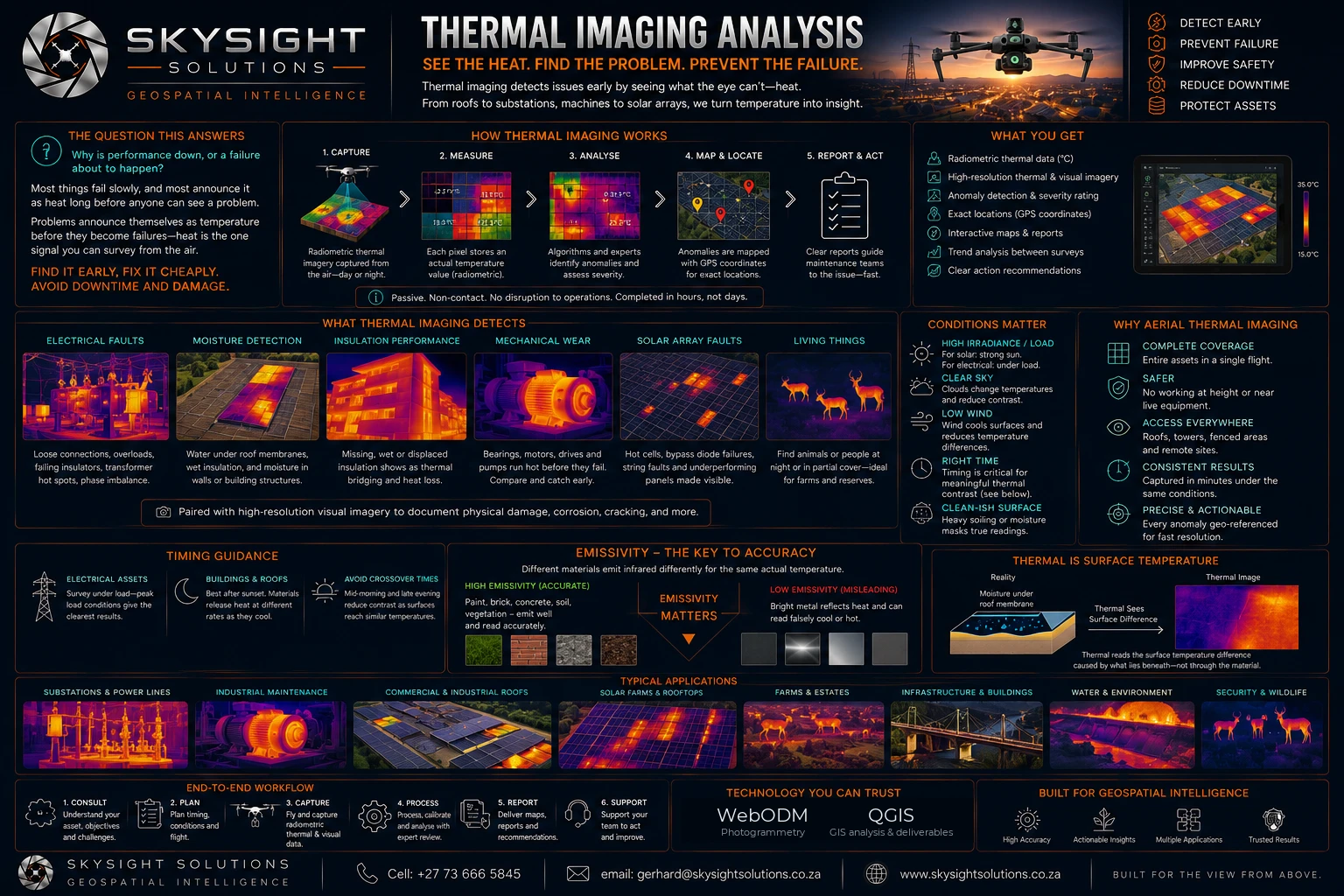
What thermal imaging detects, why emissivity is the key to accuracy, and why thermal reads surface temperature rather than seeing through material.
 View full size
Detailed infographic — tap or click the image to open it full size for reading.
Thermal imaging detects problems early by seeing what the eye cannot — heat. From roofs to substations, machines to solar arrays, it turns temperature into something you can act on.
Six categories of fault show up clearly: electrical faults including loose connections, overloads, failing insulators and transformer hot spots; moisture under roof membranes and in walls; missing, wet or displaced insulation showing as thermal bridging; mechanical wear in bearings, motors and pumps that run hot before they fail; solar array faults; and living things, which makes the same sensor useful for finding animals or people at night.
Two ideas on this graphic are worth understanding properly. The first is emissivity: different materials emit infrared differently at the same actual temperature. Paint, brick, concrete and vegetation read accurately. Bright bare metal emits very little and reflects a great deal, so it can read falsely cool — or reflect something warm nearby and appear misleadingly hot. Getting this right is one of the clearer dividing lines between flying a thermal camera and doing thermal analysis.
The second is that thermal reads surface temperature. It does not see through material. Moisture under a roof membrane is detected because it changes the temperature at the surface above it — not because the camera looks through the membrane.
Which is why timing matters so much. Electrical assets are surveyed under peak load. Buildings and roofs are best after sunset, when materials release stored heat at different rates. And mid-morning and late evening are avoided entirely, because surfaces reach similar temperatures and contrast falls away.
Want this applied to your own property, site or asset?
Book a Consult